Showing posts with label Realistic Fiction. Show all posts

Sunday, July 21, 2013

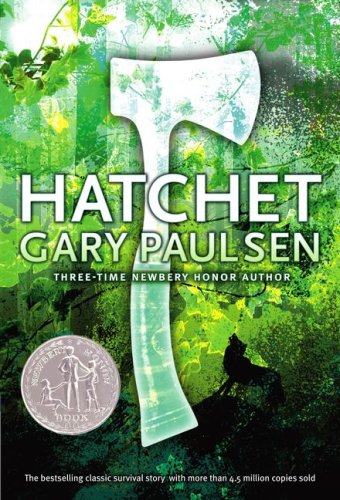
Hatchet

By Gary Paulsen
New York:  Simon Pulse (1987)

Today more than ever, divorce is one of those topics that kids should learn about and feel comfortable discussing.  With such a high rate of divorce in our country, it is inevitable that as teachers, we will encounter various children struggling with or living with divorce as their reality.  That is why good literature about divorce is crucial to have on hand and to discuss in the classroom, whether in a group or individually.  The inside cover of Hatchet states that the story is one of dual survival:  Brian must learn to survive the Canadian wilderness as well as his parents' recent divorce.  Ultimately, I was disappointed with the second aspect of this story.

Brian has a Secret, a great Secret that he is afraid to tell is father but that prevents him from looking at his mother in the same way.  So when his mother drives him to the airport to go and stay with his dad for a few months over the summer, Brian does not know what to think.  Unfortunately, the pilot has a heart attack while they're in the air, and Brian is forced to fly the plane until it runs out of fuel, at which point he maneuvers it to crash in the safest way he can think of.  He survives, but he runs into one problem after the next as he finds a way to build shelter, feed and protect himself, and hopefully attract the attention of the search party he is sure is looking for him.

One aspect of the story I did like was the emphasis on using the skills and the materials available to you.  Brian uses every resource he has, from his shoe laces to the tattered windbreaker he crashed in, and as time goes by he learns how to use the resources abundant in the forest around him.  However, Brian is thirteen years old, and I had difficulty accepting some of the skills he was able to perform.  For instance, Brian figures out how to build a bow--in two tries.  He only runs into wild animals a handful of times in the nearly two months he is stranded, and only once does that animal try to hurt him.  He builds a shelter by weaving branches of trees together tightly, even creating a chimney for the smoke to exit.  While these are commendable skills that largely contributed to his survival, I just kept wondering how realistic it was for a thirteen-year-old to know how to perform them.  Finally, putting all of this aside, these skills did not contribute at all to his rescue.  Once he was finally able to get into the sunken plane and retrieve the survival pack (inside which everything was miraculously intact, despite being submerged for two months), what saved him was an accidental press of a button on a device that turned out to be an emergency transmitter.  When he was finally found, he was not cooking the birds and fish in the way he had learned to do through experience, but was boiling in pots a large turkey dinner for four.  I did not like this because it suggested that everything he had done previously did nothing to save him--only the "creature comforts" he had just found really helped him.

However, my main issue with the work was not in plot, but in theme.  For the first half of the book, it is evident that Brian really struggles with his parents' divorce.  He saw something he wished he had not, and is afraid to tell anyone about it because it brings up his own complicated feelings.  The first half of the story mentions frequent bouts of contemplation about the divorce, his own feelings, and what life would be like from then on.  After this first half, however, the theme almost entirely disappears.  Abruptly, the narrative focuses only on the literal survival in the wilderness.  As I was reading, I kept assuming that the circle would close in the end, that he would apply his newfound physical maturity to his emotions about his family.  Even in the epilogue, however, only the last three sentences are dedicated to the divorce.  Paulsen writes, "for a week it looked as if they might actually get back together" and "Brian tried several times to tell his father, came really close once to doing it, but in the end never said a word about the man or what he knew, the Secret" (p. 189).  And that is where the story ends.  This made me very upset when I first read it because it does not show any emotional growth.  I think that the focus should not be on whether the parents get back together, but instead how they go forward as a family (even one broken apart).

That last line, though, is my least favorite part of the story.  Brian never spoke to his father about what he knew; if a child is reading this and has questions for his own parents about their divorce, this would not encourage him to be open about his feelings or opinions.  I think it is important that children communicate their feelings, good or bad, about such difficult topics, especially with those they are closest to.  Brian's example does not encourage this communication, and for that reason I don't think I would use this book if a student comes to me struggling with divorce in his family.

That being said, I don't think this book should be excluded from the classroom.  It is an exciting survival story of just an regular boy, and I'm sure that kids would enjoy reading about how he finds resources around him.  To teach about divorce or offer resources to students, however, I think I will at the very least find other stories in which the children are allowed to confront and express their feelings, and offer those examples in combination with this one.

Wednesday, July 17, 2013

Ruby Lu, Brave and True

by Lenore Look and illustrated by Anne Wilsdorf
New York:  Atheneum Books for Young Readers (2004)


In Ruby Lu, Brave and True, Lenore Look illuminates the magical world of a child's imagination.  Ruby Lu is an (almost) eight year old Asian American girl who is experiencing some brand new things.  She has a baby brother (who gives away her magician's secrets!), she goes to Chinese school (on Saturdays), and she even learns to drive!  In each chapter, Ruby performs in her own magic shows, finds out that bullies sometimes "just need a blanket," and learns Chinese.  She also learns some important lessons, like the value of making a new friend--"You never know when a new friend might become another best friend" (p. 7)--and the importance of family.  Through lighthearted anecdotes and creative phrasing, Lenore reminds the reader how thin the barrier is between reality and imagination when you wear a mysterious magic cape that "makes you look as old as ten and very sophisticated" (p. 28).

One of my favorite aspects of this novel is Look's use of language.  She repeats certain phrases multiple times across the chapters so that young readers can get an idea of how flexible figurative language can be.  I particularly love when "Ruby's tongue drops out" (p. 29), like when she meets her new Chinese school teacher, who is a beautiful princess who used to be able to turn into a mermaid.  Look goes on to explain this phrase, in this case by describing how Ruby does not know what to say.  The use of the funny phrase, rather than just the more common explanation, grabs the reader's attention and makes her think about what Look might mean.  With young readers, this is very helpful in building figurative vocabulary and awareness.

I also really like the fact that Look writes the way Ruby thinks.  With childish (but still sophisticated) language, the reader can glimpse into the world of childhood, where magic capes can transform you into a tree frog and tights can make you a gecko.  New experiences are described in a way that young readers would understand, and the experiences are not unique to a child who attends Chinese school.  For instance, although Ruby does struggle to learn Chinese, she also deals with a neighborhood bully, which many kids can understand.  Through the use of common, every-day experiences, Look presents Ruby's life in a light that children can relate to, regardless of nationality.

Finally, the illustrations are perfect for the tone of this book.  The limited pictures show Ruby's main emotions:  when she is mad at her brother, when she is exuberantly driving a car, and when she and her neighborhood friends tentatively go to Christina's house after she comes home from the hospital.  They augment the story without giving it completely away, which gives aid for young readers without allowing them to rely completely on the drawings.  One really cute detail is that the bottom right hand corners of the pages comprise a flip book of one of Ruby's magic tricks!  Flipping through these pages creatively engages children with the story in a new way.

I really enjoyed this story for several reasons.  The themes are appropriate and relatable for kids; the language used is creative and introduces many techniques of figurative language; the illustrations depict key scenes and emotions without giving away too much of the story; and, the plot line itself is swift and allows lessons to be told in a succinct, understandable way.  This would be a great read aloud and a way to promote cultural understanding in an elementary classroom.

Monday, July 15, 2013

Wonder

By R.J. Palacio
New York:  Random House (2012)


It had been a very long time since I'd picked up a book from the JF section of the library, so I knew it would be very interesting to travel back in time to that middle-school world of scary new experiences and insecurities. The very first page of RJ Palacio's Wonder took me right there.

From that first page, the reader knows that August "Auggie" Pullman is special.  Because of a rare birth defect, 10-year-old Auggie's face is severely deformed, despite dozens of surgeries aimed to help.  He knows he looks different, and describes in painful realism many different encounters he has had throughout his life in which people are horrified and shocked by his looks.  As a result, he is even more nervous about starting middle school--he has never been to school before and does not really want to go now.  The rest of the story follows August's life as he struggles with various middle-school evils:  bullies, the lunch room, hard class work, and the complicated social system in which friend groups seem exclusive and permanent to an outsider like August.  Along the way, he has to learn how to handle being outcast, made fun of, and talked about for his looks.  In the end (I won't give away the whole story!) Auggie understands himself better and, even, comes to accept the way he looks as something that makes him unique, but does not define him.

These revelations also help many other characters in Auggie's school.  At the beginning, almost everyone shuns him, and the social circles mess with him more than most other kids.  However, as we read his story, the perspective shifts from August to other friends and family members, each told in a distinctive voice and style.  I think that this is one of the great strengths of this book.  As the reader switches back and forth, we are getting multiple points of view of the same story and, as a result, we see what August can't yet:  he is impacting so many people in a very positive way just by being himself.  One example of this is when Summer, one of his only friends, is invited to a party with the popular kids, who tell her that if she stopped hanging out with August, she could be "one of them."  Instead of caving under peer pressure, Summer calls home and asks to leave.  This strength of character is the first sign that August will be alright in middle school:  if he has one friend standing by him no matter what, he will be able to get through tough times.

Another strength of this novel is the fact that the experiences August has are typical ones, made atypical only by his unusual looks.  For instance, he gets into a fight with his best friend, Jack, and the two have to apologize and make up.  He has science projects and social studies projects.  He has birthday parties; dresses up for Halloween; attends school plays.  These are events to which so many children can relate, and the insecurities that August wears on his sleeve, many children feel inside.  I think that sometimes, an extraordinary example is used to illustrate feelings that everyone has.  In this case, students entering fifth grade all share anxieties that they won't fit in, won't be popular enough, won't have anyone to sit with at lunch.  But August Pullman sets an example that if you are true to yourself, good people will find you.  More importantly, you might just find the good in people that, at first glance, seemed not to be there.

This story is about a boy's journey through fifth grade, but it is also a story of overcoming fears, growing up, and accepting yourself and those around you whom you don't understand.  One of my favorite sections of the novel is on page 252, in August's chapter "Known For:"  "As much as I love Star Wars, I don't want that to be what I'm known for.  Everyone's known for something in middle school....I'm not sure what I want to be known for, but it's not that.  That's not exactly true:  I do know what I'm really known for.  But there's nothing I can do about that.  A Star Wars duffel bag I could do something about."  This quote shows tremendous growth on August's part, who, at the beginning of the story covered up his face by any means possible and hated being recognized.  This shows that he is beginning to embrace his differences from other people, but that he is comfortable enough to know now that he can be known for other things as well.  When people finally took the time to get to know August and treat him like just another person, he began to think of himself the same way.  In the end, he is celebrated for his differences, just as we should celebrate our students' differences and use them as teaching and learning activities.

The messages in this book are great for students in this awkward transition period.  I found it unique that instead of only leaving the reader to figure out the themes, Palacio also used one of the teachers as a "voice of reason." The precepts this teacher shared with his students are then listed together at the end of the book.  This was very clever, because it means that readers who may not have gotten each of these themes from the story itself can still think about their implications.  Auggie's precept, of course, is a great ending point for the story, and I think for this blog post as well:

"Everyone in the world should get a standing ovation at least once in their life because we all overcometh the world" (p. 313).

If students believed in themselves the way August learns to, middle school might be an easier place.  Until that happens, August Pullman sets a great example.