Showing posts with label Grades K-4. Show all posts

Thursday, July 25, 2013

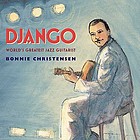
Django: World's Greatest Jazz Guitarist

by Bonnie Christensen
New York:  Flash Point/Roaring Book Press (2009)


Jean "Django" Reinhardt was born in Belgium in January 1910 and grew up living a wandering gypsy life, "Always moving place to place,/Country to country/...Hard life everywhere" (pages not numbered).  Bonnie Christensen's biography describes his life with vivid language and stunning illustrations, showing the reader both his hardships and his triumphs.

In Django:  World's Greatest Jazz Guitarist, the reader learns the importance of music in Django's life.  Although he is ever-moving, never stable, music holds a certain power for him.  There are pages and pages of beautiful illustrations showing the movement of dancers and musicians at night, enjoying the rhythm and the freedom of making music.  On one page in particular, one dancer breaks the frame that surrounds every other illustration; her hand floats up in the air, her eyes are clothes, and the reader gets the feeling that she is losing herself in the song.  Meanwhile, we follow Django as he grows up, catching fish and meat for dinner even as a boy.  Later, we see him playing on the streets of Paris, where he was called "Gypsy Genius" and "Prodigy Boy."  Tragically, he suffers terrible burns when he is 18 years old on his hand and leg, and the doctors said he would never play again.  These pages, in stark contrast to the bright colors of the rest of the book, are lean.  He is surrounded by bare, white walls and empty beds in the hospital, and people appear on the edges of the page, as though they don't want to get close.  The text echoes his loneliness and despair.  However, once the bandages are off, he picks up a guitar and teaches himself a new way to play with his non-functioning fingers.  In the end, he plays for a group of people who, at first doubtful of his skill, are so happy to hear him play once again.

This is an amazing story.  I had never heard of Django, but I looked up some of his music and he is amazing.  On the inside of the book jacket, Willie Nelson is quoted saying, "No one has ever equaled his sound or technique."  Learning about this musician and all that he went through was very inspiring and definitely exposed me to a new kind of music.  This would be a great book to read to students when studying different types of music because Django came from such an unusual background.

The illustrations in this book are incredible.  They are delicate yet deliberate, showing distinct expressions even on slightly blurred faces.  The colors are vibrant and convey the message of deep joy in music, and the use of the frame around each page remind the reader that this is a biography.  A great story to introduce the struggles that artists often go through, Django is definitely an excellent addition to any classroom library.

Django:  World's Greatest Jazz Guitarist won the Schneider Family Book Award in 2010.

Monday, July 8, 2013

Glass Slipper, Gold Sandal: A Worldwide Cinderella


                           by Paul Fleischman and illustrated by Julie Paschkis
                                        New York:  Henry Holt and Co.  (2007)

In a Disney-fied country where the word "princess" brings to mind a sparkly dress, matching crown, and glass slippers, it can be easy to remain unaware of the long tradition of fairy tales in other cultures which far predate our own.  In Fleischman's retelling of the familiar tale of Cinderella, cultures which are normally never associated are represented on the same page, introducing new insights to the traditional story of a mistreated girl who finally finds love.  The translations from different countries--including Mexico, Zimbabwe, Indonesia, Russia, and Ireland, among many others--seamlessly tell the familiar story without any disconnects other than differing cultural details.  For example, when the girl is dressing for the ball, Fleischman represents different countries' ideas of her garments: in Indonesia, she wears "a sarong made of gold," while in China she wears "a cloak sewn of kingfisher feathers" and in Japan "a kimono red as sunset."  Still, these details do not distract from the story in the slightest.  On the contrary, they offer a new insight into unfamiliar traditions and cultures.

The very beginning and the very end of the story, however, are purposely generic.  In this way, Fleischman maintains the universality of the tale, rather than giving one example of a beginning and an end.  I appreciate this detail because it calls attention to the unique format of the book:  it creates a frame that forces the reader to think back and notice all the details.  This could easily have been lost had Fleischman chosen to focus these pages on one specific culture.

The illustrations are an integral part of the unique format of the story, as well.  Each section of the story is labeled and decorated with a distinct color and style to identify the source country.  These colors remain consistent throughout the book; when a pink section comes up, for instance, the reader knows the words are from India.  The figures themselves, too, change with the cultural source.  The girl and her sisters look different on pages from Ireland, for example, than on pages from Japan.  Even more impressive, however, is the illustration work in the background of the pages.  Included in each drawing is not only the scene being described but also certain distinct cultural or national symbols.  On German pages, for instance, the characters have side buns, as is often represented, and the Irish pages contain Irish knots and Celtic-style designs.  To master one of these styles would be an impressive feat on its own; Paschkis has somehow managed proficiently represent them all in a recognizable and respectable way.

In the end, the reader/viewer is left with a sense of comfort and familiarity:  in substituting details from other nations, Fleischman adds nothing that completely changes the plot of the tale.  Because it is remarkably similar to the story our children are used to hearing, it allows them to focus on the new details:  that the Indian Cinderella wears diamond anklets instead of glass slippers, or that the Russian Cinderella finds her outfit in a birch tree.  The familiar plot line and ending allow children to instead open themselves up to learning about these new and unfamiliar people who, they might realize, are really not much different from us.