Showing posts with label Fiction picturebook. Show all posts

Thursday, July 11, 2013

Russian Folk Tales

                                Retold by James Riordan and illustrated by Andrew Breakspeare
                                             New York:  Oxford University Press (2000)


If there are two things I am passionate about, they are all types of literature, and Russia.  Anything Russian at all.  So it's surprising that I haven't picked up any Russian fairy tales before this collection.   In James Riordan's retelling of these tales, apparently collected and translated from original sources, I found yet another window into the mysterious Russian lifestyle; this time, through words meant for children.

The classic and most well known of the Russian tales is "Vasilissa the Wise and Baba Yaga."  I had heard before about the (in)famous Baba Yaga, who is contrarily evil and kind in various Russian tales, but I had never before experienced the forms that this takes.  The story starts out similarly to our tale of Cinderella, with one key difference:  there is no prince.  Vasilissa's mother dies when she is still very young, and leaves her with a doll and a set of instructions:  "Take good care of this doll and show her to no one.  Whenever you need help, give the doll a bite to eat and...she will tell you what to do" (p. 6).  Of course, Vasilissa's father eventually remarries a nasty woman with two horrible daughters, all of whom torment Vasilissa by forcing her to do chores.  Whenever she is overwhelmed, Vasilissa's doll helps her finish her tasks.  The main task of the story is when the lights all go out and the sisters tell Vasilissa to get a light from Baba Yaga, who lives far away.  After being trapped by Baba Yaga for two days, Vasilissa manages to escape:  the doll tells her to be kind to the servants and animals that usually do Baba Yaga's bidding (she gives her headscarf to the servant girl, for example, a pie to the cat, a bone to the dog).  She also takes a light from Baba Yaga's land, which is actually a lit skull.  When she brings it back to her evil family members, they are burnt up from its gaze.  Vasilissa and her father live happily after that, and Vasilissa keeps her doll "just in case she might need her again" (p. 17).

This story is quite different from ones we often tell children.  Rarely do the bad guys burn up in the end from the glare of a lit skull.  However, the overall message that good triumphs over evil remains true, as does the idea that good deeds will take you far.  (Although the Baba Yaga does live on to traipse through many other fables.)  Unlike our Cinderella, Vasilissa is not saved by a prince, but rather by her own actions.  In a culture which historically has treated its women almost as equals with its men, this fact is perhaps not so surprising.

The second story I read was "Ivan the Fool and the Magic Pike."  In it, a foolish and lazy younger brother goes to fetch water from the frozen river.  To his surprise, he catches a talking fish, which convinces him to let it go by promising him the power to grant any wish he likes.  Lazy Ivan uses this to his advantage, reciting the magic words, "By will of the pike, do as I like!" before any task he needs to get done.  Soon, word about Ivan's powers reaches even the Tsar, who sends for him by tempting him with a set of new clothes.  Once Ivan arrives (he orders his stove to take him there so he can remain warm and comfortable), the tsar tells him he is in trouble for disrupting the villagers.  At the same moment, Ivan falls in love with the tsar's daughter, Ludmila, and wishes that she would fall in love with him.  When the tsar discovers this, he banishes them both, but Ivan wishes them back to shore and then wishes them a castle.  In the end, the tsar finds out and, when he realizes Ivan can destroy his kingdom if he wanted to, gives Ivan and Ludmila his blessing.  Later, "Ivan the Wise became the best ruler Rus has ever known" (p. 26).

Unlike the previous story, I struggle to find a moral point to "Ivan."  Perhaps the point was merely to entertain; this certainly is a fun, silly story in which everyone everyone ends up happy.  The transition of Ivan the Fool to Ivan the Wise is interesting, since there is no actual character development across the story.  In fact, an analysis of this story could even suggest a negative moral implication because his laziness pays off in the end.  As such, I choose believe it is just a funny story to tell children that does not necessarily try to teach a lesson.  Many Russian authors who wrote much more recently have adopted this style, so it stands to reason that fairy tales might used as a model.

"Fenist the Falcon," the third story I read, again features Baba Yaga, this time in the complete opposite role.  A young, selfless daughter, Marushka, becomes the mistress of the house after her mother dies.  She asks her father for one thing only:  a feather from Fenist the Falcon.  After many long trips searching to find this feather, the father is finally successful.  It turns out that the feather is magic, and at night the falcon turns into a boy, Fenist, trapped in falcon form by an evil spell.  When Marushka's selfish sisters banish Fenist, Marushka leaves on the long journey to find him.  She must "go to the ends of the earth; wear out three pairs of iron shoes and three iron staffs, and eat through three stone loaves" (p. 46) before she can reach her love.  She of course begins this trek and, one by one, wears through the shoes, staffs, and loaves of bread.  Along the way, she meets Baba Yaga, who gives her advice on how to reach the castle in which Fenist is trapped.  When she finally reaches this place, she bribes the queen to let her see Fenist three nights in a row; however, the queen drugs him to sleep so Marushka cannot awaken him.  On the last night, Marushka cries, and a tear falls on Fenist, breaking the spell and setting him completely free.  In the end, the queen is banished from the land.  Marushka takes her place because, as the story ends, "she was bold and wise and strong" (p. 52).

Similar to "Vasilissa," this story commends the extended efforts, patience, and determination of the young female protagonist.  I particularly enjoyed this story as I was reading it because it contains certain elements characteristic of fairy tales, especially the repetition of key events and phrases.  For instance, each of the three times Marushka meets Baba Yaga, she sings a little song to her hut in order to be allowed in.  This kind of repetition makes stories easier to recall and repeat orally, and it also helps children listening to the story remember it and engage in it.  As I read, I was thinking that this tale is almost an opposite-version of our Sleeping Beauty, in which the prince has to travel to the wake the princess.  I like this telling of a journey for love because it emphasized the difficulty of the adventure as well as rewarded her efforts.  No one violently died, and the queen was simply banished from the land. I think this is definitely a story to tell children here in America, perhaps in conjunction with Sleeping Beauty.  Then we could invite them to make the comparisons and discover their feelings about the fluid gender roles across the tales.

Although I enjoyed the translations of the stories, Andrew Breakspeare's illustrations could have been more effective.  The drawings were beautiful, and the placement of artwork seemed typical for a collection of fairy tales.  For example, there were introductory pictures on the beginning page, occasional full-page illustrations, and smaller drawings of specific important objects at crucial parts of the story.  The end of "Fenist"features a drawing of one lone feather, reminding the reader where the whole story began.  My main issue with the illustrations is that they did not seem inherently Russian.  They could have accompanied the stories if they had been from any other culture.  In a collection specifically comprised of Russian tales, translated from original tellings, Russian-style illustrations could have increased the engagement with the tales as well as made students more curious about the culture.

Still, as it is, this book offers a great view into the plentiful world of Russian folk and fairy tales, and I look forward to reading more in this same genre.

Tuesday, July 9, 2013

Cinderella, retold by Cynthia Rylant

                                      Retold by Cynthia Rylant with pictures by Mary Blair
                                                       New York:  Disney Press (2007)

I never was a Cinderella girl, who watched the Disney movie ad nauseum until I had it memorized.  I liked Hercules, and the Lion King, and, if there had to be a princess, I liked her paired with a Beast. So when I first pulled this book off the shelf, I had no idea what awaited me.  I opened it expecting to find a familiar story, heard so many times before that I had stopped listening.  Instead, I saw beautiful drawings coupled with beautiful sentences that opened up the story and gave it a depth and meaning I hadn't seen in a long time.

The Cinderella that Cynthia Rylant tells is simultaneously the same as the Disney movie and completely different.  The plot details, of course, tell the same story that we are all familiar with.  From beginning to end, however, Rylant emphasizes that Love was Cinderella's one dream and desire.  Literally, the end--the back cover bears just the sentence, "In silence, Love found them," along with an illustration of a glass slipper surrounded by a rose bush.  Rylant manages to address the cruelty and unfairness of Cinderella's stepfamily while still keeping the optimism and hope of Love finding her in the end.  The language is serious and descriptive, giving the reader the feeling that even though Cinderella is not in control, Rylant will take care of her.

The pages are filled with the original illustrations on which the Disney movie was based.  The soft edges of Mary Blair's pictures support the storyline of a young girl dreaming of a more hopeful future.  Her use of colors, too, supports the romantic storyline, as she ties in many shades of pink, sparkles, and flowers.  The familiarity of the images also helps the reader to recognize the slight differences in Rylant's telling, how she focuses not on the details of the plot but instead on the emotions and backgrounds of the characters.

Everything about the book is magical and peaceful, and I kept turning the pages eager to see what happens next as though the story were brand new.


Monday, July 8, 2013

The Kissing Hand


                           by Audrey Penn and illustrated by Ruth E. Harper and Nancy M. Leak
                                                        Washington, DC:  Child & Family Press (1993)

As the foreword to this story discusses, children are often faced with difficult situations that they may not know how to handle.  In this gentle and love-filled picturebook, young Chester Raccoon is nervous about going to school for the first time and leaving his mom behind.  These nerves are a great example for young readers because Chester mentions reasons that many children can understand:  he wants to play with friends and toys, read books, and swing on swings.  His mother reassures him first by pointing out all the fun things he will get to do in school and then sharing with Chester the secret of "the kissing hand," which is a kiss in the middle of his palm that reminds him, whenever he feels sad or lonely, that she loves him.  

The illustrations match the text well.  Even though the characters are raccoons, Harper and Leak manage to portray real emotions on the pages.  Chester has tears in his eyes, for instance, when he is initially telling his mom about his fears.  Later, when he learns about the kissing hand, both Chester and his mother are looking down at his palm in a way that conveys comfort and understanding.  Mrs. Raccoon is drawn in a motherly fashion:  her arms are around Chester when he is sad and her hand forms the sign for "I love you" as he runs off to meet his classmates.  These small details add to the experience of the story by reinforcing the idea of familial stability even when children are uncertain.

Chester's emotions can also remind students that being nervous before school is natural and okay; many other children are probably feeling the same way.  Mrs. Raccoon's gentle reaction to Chester's fears can reassure children that they will have support when they face a new situation.

My favorite part of the story comes just before Chester runs off to school.  His mother has already shared the Kissing  Hand with him and told him that she loves him.  In return, he kisses her hand to remind her that she, too, can be comforted by his love.  A sentimental story about the power of love, The Kissing Hand is a great read for the beginning of the school year to young children to remind them that though they might be experiencing something new, the love of a family member or friend can help them through it.

Glass Slipper, Gold Sandal: A Worldwide Cinderella


                           by Paul Fleischman and illustrated by Julie Paschkis
                                        New York:  Henry Holt and Co.  (2007)

In a Disney-fied country where the word "princess" brings to mind a sparkly dress, matching crown, and glass slippers, it can be easy to remain unaware of the long tradition of fairy tales in other cultures which far predate our own.  In Fleischman's retelling of the familiar tale of Cinderella, cultures which are normally never associated are represented on the same page, introducing new insights to the traditional story of a mistreated girl who finally finds love.  The translations from different countries--including Mexico, Zimbabwe, Indonesia, Russia, and Ireland, among many others--seamlessly tell the familiar story without any disconnects other than differing cultural details.  For example, when the girl is dressing for the ball, Fleischman represents different countries' ideas of her garments: in Indonesia, she wears "a sarong made of gold," while in China she wears "a cloak sewn of kingfisher feathers" and in Japan "a kimono red as sunset."  Still, these details do not distract from the story in the slightest.  On the contrary, they offer a new insight into unfamiliar traditions and cultures.

The very beginning and the very end of the story, however, are purposely generic.  In this way, Fleischman maintains the universality of the tale, rather than giving one example of a beginning and an end.  I appreciate this detail because it calls attention to the unique format of the book:  it creates a frame that forces the reader to think back and notice all the details.  This could easily have been lost had Fleischman chosen to focus these pages on one specific culture.

The illustrations are an integral part of the unique format of the story, as well.  Each section of the story is labeled and decorated with a distinct color and style to identify the source country.  These colors remain consistent throughout the book; when a pink section comes up, for instance, the reader knows the words are from India.  The figures themselves, too, change with the cultural source.  The girl and her sisters look different on pages from Ireland, for example, than on pages from Japan.  Even more impressive, however, is the illustration work in the background of the pages.  Included in each drawing is not only the scene being described but also certain distinct cultural or national symbols.  On German pages, for instance, the characters have side buns, as is often represented, and the Irish pages contain Irish knots and Celtic-style designs.  To master one of these styles would be an impressive feat on its own; Paschkis has somehow managed proficiently represent them all in a recognizable and respectable way.

In the end, the reader/viewer is left with a sense of comfort and familiarity:  in substituting details from other nations, Fleischman adds nothing that completely changes the plot of the tale.  Because it is remarkably similar to the story our children are used to hearing, it allows them to focus on the new details:  that the Indian Cinderella wears diamond anklets instead of glass slippers, or that the Russian Cinderella finds her outfit in a birch tree.  The familiar plot line and ending allow children to instead open themselves up to learning about these new and unfamiliar people who, they might realize, are really not much different from us.

Sunday, July 7, 2013

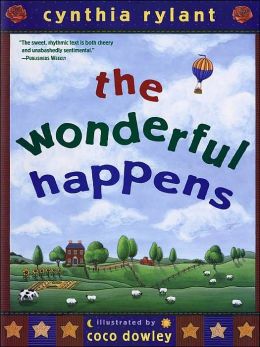
The Wonderful Happens


                                               by Cynthia Rylant and illustrated by Coco Dowley
                                           New York:  Simon & Schuster Books for Young Reader (2000)


The Wonderful Happens describes the beauty of the little things in life in a simple, formulaic picturebook for young children.  The repetition of certain key phrases helps children follow along with the reader, and the use of common, everyday objects makes the subject relatable.  The illustrations are drawn in a familiar style, depicting recognizable objects and settings in comforting colors, with each page having a single theme or focus.

The text introduces natural processes in an easy-to-understand way.  For instance, the process of making bread is simplified to:  "The Earth grew wheat, the wheat made flour, and the wonderful happened:  bread."  Such descriptions are a good way to introduce the idea of processes to young children, who are beginning to ask many questions about the things they see around them on a daily basis.

Not only does the text present common vocabulary (bread, bird, rose), encouraging the beginning stages of literacy, but it also brings the focus back to the child for the conclusion by adding "you" to the list of wonderful things.  This reinforces in a simple way the idea that each child is unique, special, and loved.

It is never too early to start seeing beauty and wonder in the even the smallest details, and Rylant's text seems like a good place to start.

Alligator Boy


                                                           by Cynthia Rylant and Diane Goode
                                                                         New York:  Harcourt (2007)


As children go through school, they can struggle with hard questions:  Do I fit in?  Will I make friends?   What if I like something that no one else does?  Rylant and Goode cleverly address these identity issues in Alligator Boy by describing a young boy who, as the inside of the dust jacket reads, "is tired of being a boy. He wants to be somebody new...."  The story tells of his decision to instead be an alligator!  He goes to school, makes friends, does homework and classroom chores, and even learns how to fight off bullies.

Disguised as a tale about an alligator boy, this book can teach children the values of being true to yourself and accepting those around you regardless of different interests or backgrounds.  The illustrations throughout the story depict the alligator boy enjoying school and playing with his friends, showing that even though he is different from people around him, they still accept and love him.  A good book to discuss with children about non-conformity, Alligator Boy is a story with a limited plot but a very important lesson.