Showing posts with label Historical fiction. Show all posts

Friday, August 2, 2013

Number the Stars

By Lois Lowry
New York:  Laurel Leaf, 1989


I have always loved Lois Lowry--The Giver and Autumn Street are among my favorite books ever.  Even though her historical fiction has a completely different feel, I am still amazed at the skill she possesses, to take the reader and put her in a completely different world, a completely different time.

In Number the Stars, a young Danish girl named Annemarie Johansen and her family have to protect her best friend, Ellen's, family from the Nazi occupation.  On the eve of the Jewish New Year in 1943, Ellen has to pretend to be part of the Johansen family so that the Nazis, who have been coming through to relocate all Jewish inhabitants of Copenhagen, will not find her.  In a dangerous journey that takes the whole family to the banks of neutral Sweden, Annemarie will have to be braver than she thought she could ever be if she wants her best friend to be safe.

In Lowry's afterword, she explains how much of the story is true and how much is fiction.  A surprising amount is actually true, which just proves that sometimes, fact can be even more amazing than fiction.  For instance, the handkerchief that mutes the search dogs' sense of smell in the book was an actual invention, made from a mix of rabbit's blood and cocaine that, soaked on a handkerchief, would simultaneously attract the dogs' attention and then render their noses useless.  The Resistance, the group to which Annemarie's family belongs, was a very real presence in Denmark, and the majority of the members were young, just like Lise and Peter.  By researching and using these small but important details, Lowry gives her work an added layer of reality into which the reader can place herself.  

This is a great story because it relates the fear and cruelty of the Nazi occupation during World War II without the gruesome setting of the concentration camp.  A great work to introduce the topic to students, I think Number the Stars would inspire some great conversation within the classroom.  Lois Lowry does not disappoint, and this work, a winner of the Newbery Award, is no exception.

My Name is America: The Journal of Douglas Allen Deeds

By Rodman Philbrick
New York:  Scholastic, 2001


When I was thinking about historical fiction books to read, I immediately thought of the "Dear America" and "My Name is America" series.  I used to read many of them, and wondered what it would be like to go back and read one now, so many years later.  When I was deciding which one to pick, however, I was stuck.  Since I'd read so many before, I had pretty much chosen the ones that I knew interested me.  That's when I saw this book on the shelf and wondered, "how on Earth will they deal with an issue as big as the Donner Party Expedition in a children's book?"  I decided I had to read and find out.

In this diary, the reader follows the Donner party through the eyes of one young traveler named Douglas Deeds (an actual member of the Donner party, although these words are fictional).  At the beginning, his entries are full of hopes and dreams for the rich land of California, where they are headed.  Slowly, however, things begin to go wrong.  People peel off of the wagon train to turn back, settle, or strike out on their own or with other groups, and the party dwindles.  There are many clashing beliefs and personalities within the group, and one wrong decision dooms the party:  they decide to take a "shortcut" through the Sierra Nevada mountain range, but their travels are harder and slower than expected, and they get snowed in.  Conditions get worse and worse, and food becomes first scarce and then nonexistent.  The group is faced with a terrible decision:  what will they do for food?

Although the diary does not come out and say "cannibalism" explicitly, it is pretty vividly described. The people in the small Forlorn Hope group were depicted as having gone insane, which was scary for me to read, let alone for a young child.  It is called "the forbidden meat" several times, and the way he describes what happens is a little confusing.  In the author's note and the brief historical summary, it is dealt with more directly, explaining the history of what happened.  Overall, I think that it was handled as well as it could be; still disturbing, but the situation is disturbing in itself.

One thing that bothered me was the discussion of both women and the Native Americans.  The treatment was true to the time period, but to children reading it now, there would (hopefully!) be a disconnect.  If students read this in school, and even if they read it at home, I think it would take some extra work to not only explain the event of cannibalism but also to explain why women were disregarded in big decisions, and why Native Americans were largely hated.

Overall, although the book was intriguing, I don't know that I would include it in my classroom.  The material, although tragic, does not apply to much else, and I don't know if a discussion of cannibalism would be appropriate in a school setting.  

Monday, July 29, 2013

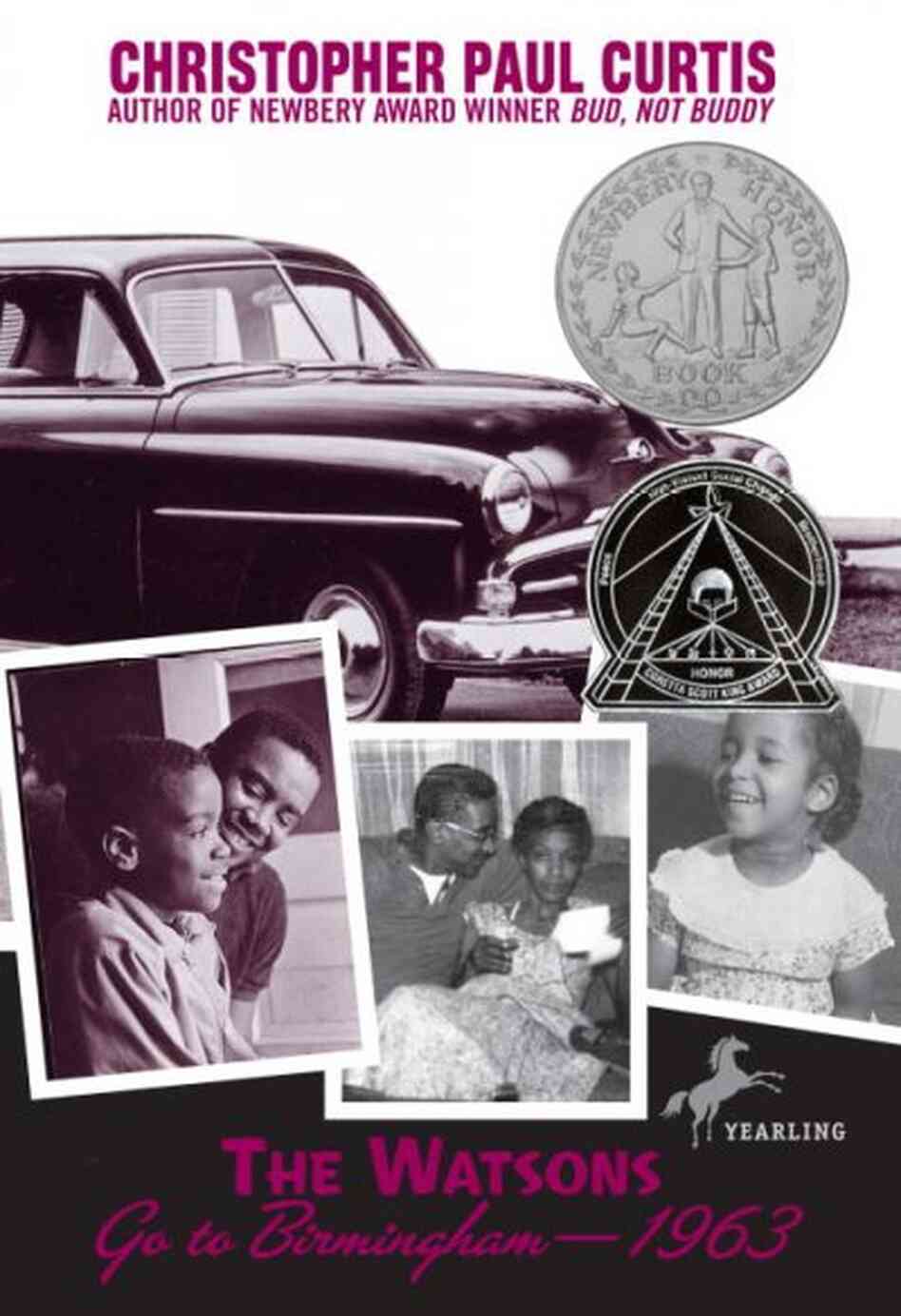
The Watsons Go to Birmingham, 1963

by Christopher Paul Curtis
New York:  Delacorte, 1995


I had never read anything by Christopher Paul Curtis before, but I had heard a lot of good things about another of his works, Bud, Not Buddy.  In addition, I knew I was going out of town when I had to read The Watsons Go to Birmingham, 1963, so I read part of the story from the book and listened to the rest on an audiotape.  It was very interesting to compare the two experiences.

In this story, the reader follows the "weird Watsons" (as the main character, Kenny, calls his family) as they go through everyday experiences--often comical--as well as a life-changing trip to visit Mrs. Watson's home town, Birmingham, AL.  The Watsons are a typical family with two sons who are always getting into trouble somehow and one young daughter who looks up to both of them angelically.  Throughout the story, we see Byron get into all kinds of trouble, from getting his mouth frozen to a car mirror to getting a "conk" (a perm and color) when his parents did not approve.  Kenny, too, finds trouble; he loses his dinosaurs in an epic war against the Germans and does battle with a deadly "Wool Pooh" in the river.  Then, the tragic bombings of Birmingham in 1963 change forever the way that Kenny and his family see the world.  The Watsons Go to Birmingham, 1963, is at the same time a humorous family tale as well as a sobering coming-of-age story.

Although I enjoyed actually reading the text of this story, I have to say that listening to it on audiobook was so much fun!  Hearing the expressions in different tones, particularly Kenny's trademark "tie me to a tree and say, 'Ready, aim, fire!'" was both entertaining and showed a window into Kenny's exaggerated black-and-white view of what is right and wrong (even if he doesn't always follow the rules himself!).

There are several themes running through this work.  First, the importance of family is evident.  Kenny's world revolves around his family; he learns social conventions from his brother, the popular kid in school, and his mother, the stern voice of reason.  Everything that either boy does wrong eventually comes back to bite them, whether it is Byron's hair or Kenny's laughing at his new friend.  The interactions between and among the family form Kenny's identity.  A second important theme, or motif, is the Civil Rights movement.  Because this story takes place in 1963, Curtis infuses examples of racist behavior into the text.  Although Kenny lives in the North (Michigan), his town is still largely segregated.  He knows only a few, if any, white people and lives and interacts mainly with kids "like him."  When the family gets to Alabama, however, things are very different.  The church bombings that Kenny almost witnesses are his first jarring example of how cruel people could be to African Americans, and these events seriously shake up his world view.  In the end, the family theme comes back.  His brother and sister pull him out of his contemplative mood and even his hiding place behind the family couch by reminding him of the good things in their lives, especially the love they all share.

This story would be excellent to include in a unit on the civil rights movement because it teaches the reader about the events of that period without preaching to them.  As this video with Christopher Paul Curtis mentions, the students really are reading a story about a family.  Through it, however, they learn so much more.  I really enjoyed this book and I would definitely like to read some other works by Curtis.

A movie is being made, as well!  Click here to read more about it.