Monday, July 29, 2013

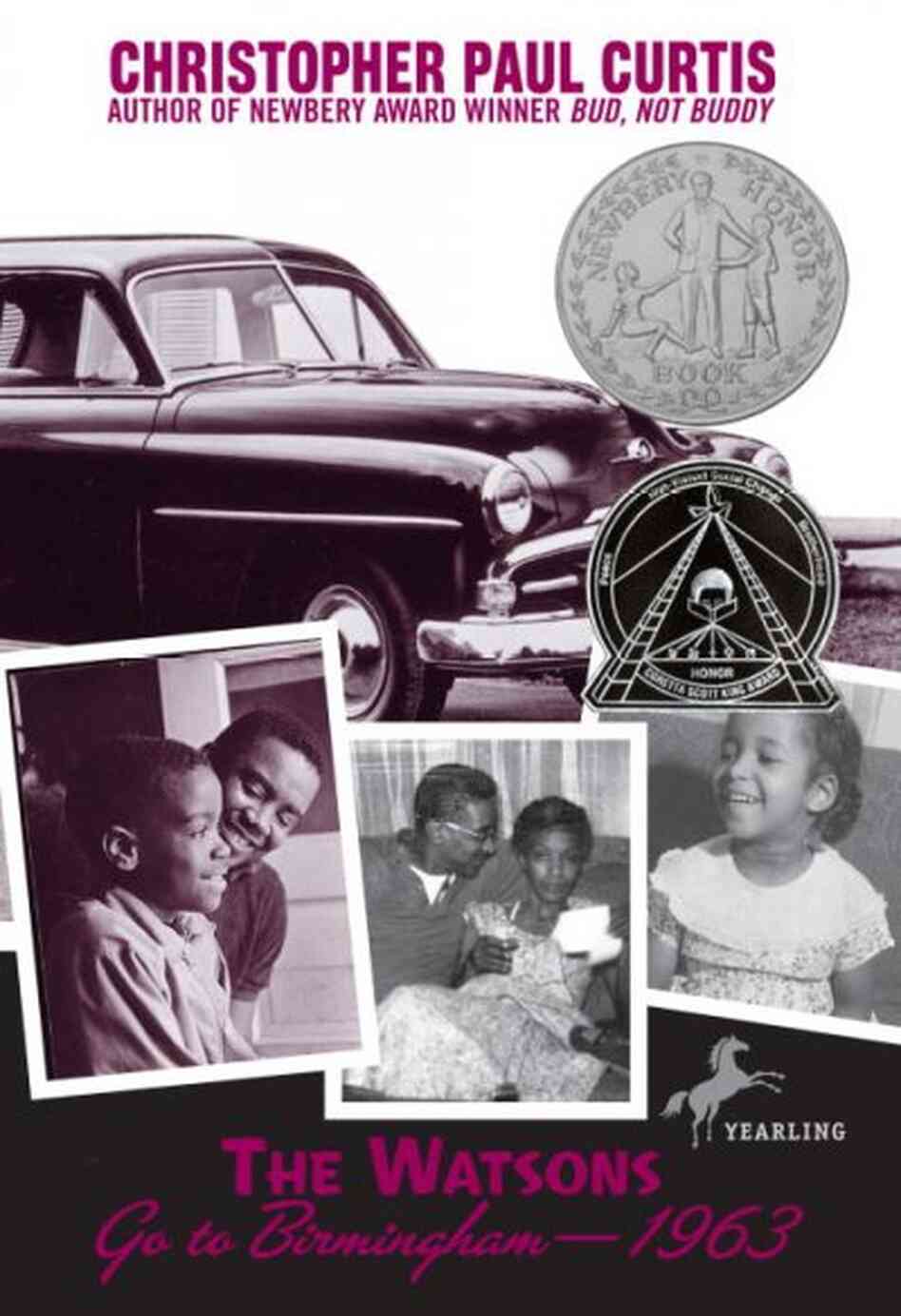
The Watsons Go to Birmingham, 1963

by Christopher Paul Curtis
New York:  Delacorte, 1995


I had never read anything by Christopher Paul Curtis before, but I had heard a lot of good things about another of his works, Bud, Not Buddy.  In addition, I knew I was going out of town when I had to read The Watsons Go to Birmingham, 1963, so I read part of the story from the book and listened to the rest on an audiotape.  It was very interesting to compare the two experiences.

In this story, the reader follows the "weird Watsons" (as the main character, Kenny, calls his family) as they go through everyday experiences--often comical--as well as a life-changing trip to visit Mrs. Watson's home town, Birmingham, AL.  The Watsons are a typical family with two sons who are always getting into trouble somehow and one young daughter who looks up to both of them angelically.  Throughout the story, we see Byron get into all kinds of trouble, from getting his mouth frozen to a car mirror to getting a "conk" (a perm and color) when his parents did not approve.  Kenny, too, finds trouble; he loses his dinosaurs in an epic war against the Germans and does battle with a deadly "Wool Pooh" in the river.  Then, the tragic bombings of Birmingham in 1963 change forever the way that Kenny and his family see the world.  The Watsons Go to Birmingham, 1963, is at the same time a humorous family tale as well as a sobering coming-of-age story.

Although I enjoyed actually reading the text of this story, I have to say that listening to it on audiobook was so much fun!  Hearing the expressions in different tones, particularly Kenny's trademark "tie me to a tree and say, 'Ready, aim, fire!'" was both entertaining and showed a window into Kenny's exaggerated black-and-white view of what is right and wrong (even if he doesn't always follow the rules himself!).

There are several themes running through this work.  First, the importance of family is evident.  Kenny's world revolves around his family; he learns social conventions from his brother, the popular kid in school, and his mother, the stern voice of reason.  Everything that either boy does wrong eventually comes back to bite them, whether it is Byron's hair or Kenny's laughing at his new friend.  The interactions between and among the family form Kenny's identity.  A second important theme, or motif, is the Civil Rights movement.  Because this story takes place in 1963, Curtis infuses examples of racist behavior into the text.  Although Kenny lives in the North (Michigan), his town is still largely segregated.  He knows only a few, if any, white people and lives and interacts mainly with kids "like him."  When the family gets to Alabama, however, things are very different.  The church bombings that Kenny almost witnesses are his first jarring example of how cruel people could be to African Americans, and these events seriously shake up his world view.  In the end, the family theme comes back.  His brother and sister pull him out of his contemplative mood and even his hiding place behind the family couch by reminding him of the good things in their lives, especially the love they all share.

This story would be excellent to include in a unit on the civil rights movement because it teaches the reader about the events of that period without preaching to them.  As this video with Christopher Paul Curtis mentions, the students really are reading a story about a family.  Through it, however, they learn so much more.  I really enjoyed this book and I would definitely like to read some other works by Curtis.

A movie is being made, as well!  Click here to read more about it.

Thursday, July 25, 2013

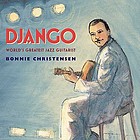
Django: World's Greatest Jazz Guitarist

by Bonnie Christensen
New York:  Flash Point/Roaring Book Press (2009)


Jean "Django" Reinhardt was born in Belgium in January 1910 and grew up living a wandering gypsy life, "Always moving place to place,/Country to country/...Hard life everywhere" (pages not numbered).  Bonnie Christensen's biography describes his life with vivid language and stunning illustrations, showing the reader both his hardships and his triumphs.

In Django:  World's Greatest Jazz Guitarist, the reader learns the importance of music in Django's life.  Although he is ever-moving, never stable, music holds a certain power for him.  There are pages and pages of beautiful illustrations showing the movement of dancers and musicians at night, enjoying the rhythm and the freedom of making music.  On one page in particular, one dancer breaks the frame that surrounds every other illustration; her hand floats up in the air, her eyes are clothes, and the reader gets the feeling that she is losing herself in the song.  Meanwhile, we follow Django as he grows up, catching fish and meat for dinner even as a boy.  Later, we see him playing on the streets of Paris, where he was called "Gypsy Genius" and "Prodigy Boy."  Tragically, he suffers terrible burns when he is 18 years old on his hand and leg, and the doctors said he would never play again.  These pages, in stark contrast to the bright colors of the rest of the book, are lean.  He is surrounded by bare, white walls and empty beds in the hospital, and people appear on the edges of the page, as though they don't want to get close.  The text echoes his loneliness and despair.  However, once the bandages are off, he picks up a guitar and teaches himself a new way to play with his non-functioning fingers.  In the end, he plays for a group of people who, at first doubtful of his skill, are so happy to hear him play once again.

This is an amazing story.  I had never heard of Django, but I looked up some of his music and he is amazing.  On the inside of the book jacket, Willie Nelson is quoted saying, "No one has ever equaled his sound or technique."  Learning about this musician and all that he went through was very inspiring and definitely exposed me to a new kind of music.  This would be a great book to read to students when studying different types of music because Django came from such an unusual background.

The illustrations in this book are incredible.  They are delicate yet deliberate, showing distinct expressions even on slightly blurred faces.  The colors are vibrant and convey the message of deep joy in music, and the use of the frame around each page remind the reader that this is a biography.  A great story to introduce the struggles that artists often go through, Django is definitely an excellent addition to any classroom library.

Django:  World's Greatest Jazz Guitarist won the Schneider Family Book Award in 2010.

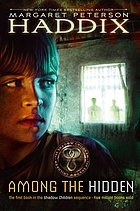
Among the Hidden

By Margaret Haddix
New York:  Simon and Schuster Books for Children (1998)

In Margaret Haddix's Among the Hidden, Luke, a young boy who has to hide his very existence from the world, finds his voice.  Ever since the government was overthrown and the Population Police began enforcing a two-children-per-household rule, third-children have to stay inside and stay hidden.  Luke has spent his entire 12 years of life inside his house, mostly in his attic bedroom, before he spies another third-child in his neighbor's home.  Risking everything, he goes over to meet the girl who will change his life.  But when her plan to save all of the hidden children goes horribly wrong, will Luke have the courage to follow in her footsteps?

This story was intriguing and had me hooked from the very first page.  Haddix describes the world to be believable by using a realistic family.  Luke's older brothers, mother, and father, are a poor farming family who love Luke but are too afraid of the Government's power to let him risk his safety even to peek out the window and see the sunlight.  Luke is depicted as a normal boy who fights with his brothers, wants to play outside, and feels lonely without friends.  His story is an allegoric coming-of-age journey as moves from his imprisoned childhood into the terrifying world of adults, without any safety or guarantees.

I really enjoyed this book.  The characters broke my heart as I was reading, thinking about a young boy who has read boring books dozens of times simply because some days he is not even allowed downstairs.  I think the theme of stepping outside your comfort zone in order to better yourself and help others is a worthy one for young children to read, and the science fiction back drop distances them enough that, even at the scariest or saddest moments, the reader can still feel safe.

This is the first book in the Shadow Children sequence by Margaret Haddix, and I am definitely interested in reading to find out how Luke's story continues!

Wednesday, July 24, 2013

Don't Bump the Glump! And Other Fantasies

By Shel Silverstein
New York:  Harper Collins (1964)


I first knew Shel Silverstein for his collection of poems and drawings, "Where the Sidewalk Ends," for "The Missing Piece," and for "Falling Up." Later, I read and loved "The Giving Tree."  However, I had never found his first poetry collection, "Don't Bump the Glump!" until a librarian recently suggested I read it.  Each page has a short poem accompanied by some imaginary creature.  Some of the names are impossible to pronounce ("Zrbangdraldnk"), but all are vividly described in an often hilarious manner.  

My favorite poem is entitled "Long-Necked Preposterous:"  "This is Arnold,/A Long-Necked Preposterous,/Looking around for a female/Long-Necked Preposterous./But there aren't any."  I laughed out loud when I read this poem, and I don't think anyone else could have written such gibberish and gotten away with it.  Another poem in the same wry sense of humor is "The Flying Festoon."  In it, he talks about riding the Flying Festoon to the moon, and makes detailed plans, only to reveal that the Flying Festoon has yet to learn how to fly.

The crazy drawings are in perfect alignment with the sometimes nonsensical poems, and I can imagine reading them out loud to a classroom of young children who would just laugh out loud.  Some poems, though, refer to things that are actually real.  In "The Zumbies," Silverstein refers to an ostrich and then flips it around by creating an animal that buries not only its head, but its whole body, when threatened.  In this way, Silverstein relates the nonsense to reality, connecting the concepts in the children's mind.  

In conclusion, I really enjoyed reading Silverstein's first collection.  I enjoy some of his other collections a bit more, particularly "Where the Sidewalk Ends."  Still, it was a fun and enjoyable read, and I think it would be a good addition to my classroom library.

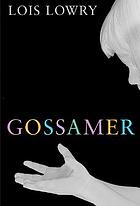
Gossamer

By Lois Lowry
Boston:  Houghton Mifflin, 2006


Nobody creates a world quite like Lois Lowry. From the opening scene of Gossamer, Lowry paints a vivid picture of a world not completely unlike ours, in which small, mysterious beings gather memories from the items in our home and then bestow them upon as dreams.  In this story, these dream givers play a crucial role in the lives of a lonely older woman and the troubled young boy she agrees to take in.  Without the help of Littlest One and Thin Elderly, the humans are in danger of suffering at the hands of the "Sinisteeds," those who bring not dreams, but nightmares.

The beginning of this story was simultaneously intriguing and frustrating.  Lowry develops her main characters for several chapters without actually telling the reader who (or what) they are.  Her tactic is very interesting:  she actually has her main character, Littlest One, questioning another character about what she is.  She says, "are we a kind of dog?" (p. 2), "might we be a type of bat?" (p. 5), and later, "might we be human?" (p. 6).  Each time, this question is preceded by some small detail about the beings, such as the fact that they have shadows, but not tails, and not wings.  In this manner, Lowry forces her reader to continually adjust her mental picture of these beings.  What are they?  Why are they there?  What is their purpose?  Although in the end I found this process helpful and even rewarding, in the midst of it I felt like she was going too far.  However, I am reading from a completely different perspective:  I have had practice reading and picturing stories for most of my life, whereas young children might need this coaxing to develop their internal "artist" for reading, picturing, and comprehending fictional texts.

The narrative with the dream givers is woven in between the stories of two humans.  The first is an elderly woman who, based on the "fragments" Littlest One gives her for dreams, has outlived her friends and family, and now lives happily, if somewhat lonely, with her dog, Toby.  The second is a young boy, 8 years old, who has been put into her hands until his mother can get back on her feet.  John is struggling with the heavy burden of understanding that his father was physically and mentally abusive to both him and his mother; throughout the story, Lowry gives more and more details to help the reader see the sad pattern his life had contained before his father "moved to California," as his 8-year-old mind understands it.  To make matters worse, the Sinisteeds are targeting the vulnerable little boy, and Littlest One must do everything she can to protect him so he can resist the terror of his nightmares.

Gossamer deals with some very tough issues.  The physical abuse of little John is explicit in the text, especially towards the end, where he tells the woman that his father punished him for wetting himself when he was three by treating him as though he were a dog.  The language is powerful and moving, and I was saddened by the descriptions of the little boy's feelings of guilt.  However, Lowry does end her note on an uplifting note:  John is starting school, his mother has a good, steady job and a supportive group of friends, and Littlest One begins to train her own dream giver, now that she has matured enough to understand the art.

I love Lois Lowry's style of writing, but I had some trouble with this book.  It is more abstract than some of her other books, and the climactic battle literally takes place in a dream world, which makes it hard to grasp.  That being said, I enjoyed learning the histories of the boy and the woman, and the idea of tiny creatures who choose what you dream about and protect you from nightmares is actually kind of comforting.  I think this would be a great read aloud because Lowry really exercises the reader's ability to form mental pictures, and uses vocabulary that is fairly advanced.  Finally, the story ends on an uplifting note, suggesting the resiliency of children and the importance of imagination and dreams.

For more information on Lois Lowry, including a list of her books and speeches, you can visit her website!

Dark Emperor, and Other Poems of the Night

by Joyce Sidman, illustrated by Rick Allen
Houghton Mifflin Harcourt (2010)


I actually used to love poetry growing up, both writing and reading it.  I liked how flexible the words could be, and how good it felt to find that certain rhyming word you'd been wracking your brain for.  Still, it has been a long time since I read anything except Shakespeare's sonnets and Spenser's sonnet cycles (which, I'll admit, I love).  So going back to children's poetry, I figured, would feel a lot different, and I was not sure I would like it anymore.

I was wrong.

Dark Emperor and Other Poems of the Night reminded me how fun playing with words can be.  Each of the poems, each about a different animal or plant that comes to life at night, creatively used rhythm, rhyme, and even shape to shed light on creatures of the night.

A great example of rhythm, and perhaps my favorite of the poems, is in "I am a Baby Porcupette" (p. 18).  This short little poem is catchy; as I was reading it, I could picture kids almost singing along:  "I am a baby porcupette/My paws are small; my nose is wet/And as I nurse against my mom,/We mew and coo a soft duet."  Each of the four verses follows this pattern of light, bouncy language and rhythm.  I think that this style would be great for children because it would help them remember the words of the poem as well as the information.  Another good example of rhythm is found in "Ballad of the Wandering Eft" (p. 24), in which there is a repeating verse.  This, similar to a mainstream song, aids memory and understanding.  On a side note, this animal was my favorite to read about:  efts are the land stage of a newt; after several years, they actually turn green, grow gills, and return to live in the water.

This brings up one unique detail about this poetry collection:  the natural information on the facing page of each poem.  This is fantastic.  The poem is a fun introduction to an animal or plant, and then, next to a full-page illustration, is a brief paragraph that details the described being.  In each, there is at least one bit of interesting or weird information.  I learned, for instance, that orb spiders eat their webs each night after they catch their prey.  This format is a huge strength of this collection because many of the animals were unfamiliar to me, so I assume even more would be unfamiliar to children.  The language is technical but still understandable in a read-aloud for young children; older children might be able to read on their own, with some scaffolding.

One of the coolest poems, in my opinion, is "Dark Emperor," about a great horned animal.  The words of the poem are actually shaped like an owl sitting on a branch.  I remember learning about this kind of poetry, but never understood the purpose.  Looking at this page, however, it clicked.  The shape of the owl really drew my attention to the words, and I love the little lines at the end:  "disregard/the tiny hiccup/of my heart/as I flee" (p. 12).  It is such a good format for a poem, I think, especially for younger children who really latch onto the visual aspects.

Speaking of which, I finally come to the illustrations.  Allen created beautiful two-page illustrations for both the front and back end pages, the first being the sunset (an introduction to nighttime) and the last being sunrise (a logical end to the collection).  Each drawing is detailed and realistic; when I turned to the page about the spider, I (an arachnophobe) honestly felt a little anxious.  One cute detail is that each picture includes not only the subject of the current poem, but also the subject of another poem.  Mushrooms, for example, are seen in the porcupette poem; a snail is seen on the mushroom page.  Every page, however, contains the newt, crawling into or around whatever is being currently discussed.  This provides some consistency across the collection, since each poem is so different from the rest.

In conclusion, I loved this collection of poems.  I would definitely include it in my classroom library, and I think it would be a great introduction to not only creatures of the night, but also poetry styles and characteristics.

Sunday, July 21, 2013

The One and Only Ivan

By Katherine Applegate
New York:  Harper (2012)


Although as a younger reader I loved fantasy novels--I could not get enough of Tamora Pierce or Phillip Pullman's series, not to mention Harry Potter--I have always had trouble connecting to animal stories.  So I opened Ivan not knowing how I would react.  And while I enjoyed reading Ivan's words, I had some trouble gleaning the main messages from them.  Still, I did think, repeatedly, as I read that I can see why children would love this story.

The One and Only Ivan is a story about a gorilla living in the "Big Top Mall" off of Exit 8.  He and a few other animals, like Stella the elephant and Bob the stray dog, live their lives much the same every day:  performing for the guests and shoppers and passing the time by talking and telling stories about their pasts.  In an effort to bring more guests in, the owner, Mack, purchases a baby elephant named Ruby.  However, Stella and Ivan are realizing how hopeless their lives are in the mall and want a different life for Ruby.  With the help of a young schoolgirl who inspires the artist in Ivan, the animals work together to try and break free of their glassed-in "domains," struggling to reconcile their pasts with their present lives.

Even though I did not connect with this book in the same way as I have with others this semester, I still enjoyed reading and studying it.  The simple sentence structure and language allow the reader to focus on the details within the story, and the modest illustrations pull out the important characters and events in the tale without distracting from the text.  I enjoyed the attention to detail in these illustrations.  For instance, whenever a new character is introduced, we see a sketch of that animal or person that tells us a great deal about him or her.  When we first meet Julia, for instance, she is sitting on a bench looking up from her sketch pad, smiling and contemplating what she is drawing.  These are important characteristics of her personality that are reinforced throughout the text, and the illustration can help young readers relate to her.

One of the main themes running throughout the narrative is that of animal rights, which I think is aided by the fact that it's told from an animal's perspective.  I think children will be able to relate more to the ways that animals should be treated if they can picture a character such as Ivan and imagine his feelings.  The power of art, too, is important to this story, as Ivan uses art to communicate his strongest desire to get out of the mall and into a zoo.

One final aspect of the story that I appreciated was that instead of ending the story when the animals left the mall and got to the zoo, Applegate took the time to show the reader how they adjusted to their surroundings.  For instance, Ivan saw that Ruby had a family, and he also gradually discovered his role in his troop.  Bob's story, too, wraps up nicely, and I felt happy that he finally had a home.  Taking that extra time to show how the animals adjusted to change, instead of just stopping the narrative when they left the mall, gives readers some closure and some insight into how humans can help take care of animals.

To sum up, although this novel is not one of my all time favorites, I did finish with that warm feeling you get when you read quality literature.  The characters are humanized and made relatable, and Applegate includes some important themes for young readers to consider.  I would definitely include this in my classroom library.

By the way, I found the trailer for this book very intriguing, as it included some of the artwork and text to pull together a creative introduction to the story.